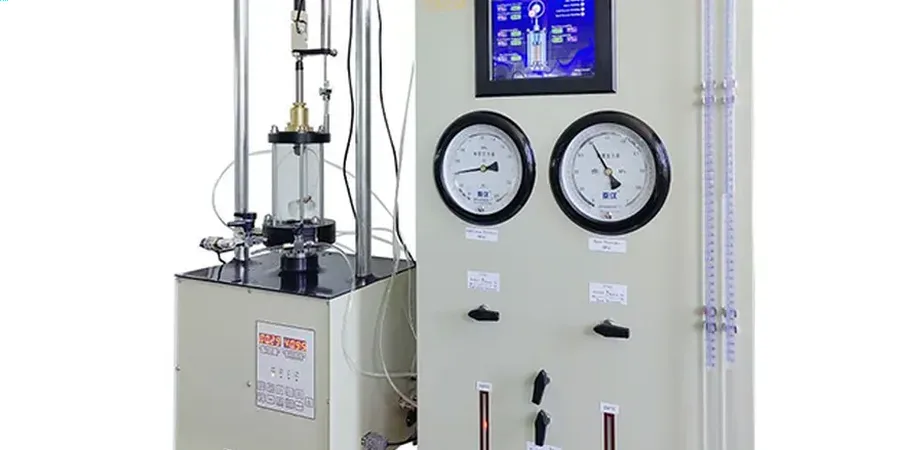
A common mistake we see in the Barrie area is designing foundations using friction angles pulled from generic correlations, without accounting for the complex stress history of the local soils. The city sits on a mix of glacial Lake Algonquin deposits—layered silty clays and tills that can lose significant strength when saturated. Getting the wrong c-phi pair means either overbuilding the footing and wasting budget, or worse, underestimating settlement and risking structural distress. A properly executed triaxial program measures how these soils actually behave under the confining pressures your foundation will impose. We run the specimens through saturation, consolidation, and shear stages following ASTM D4767 for consolidated-undrained conditions, giving your structural engineer a reliable Mohr-Coulomb envelope instead of a textbook guess. For clients working near the Kempenfelt Bay shoreline, where soft compressible layers are common, we often pair the triaxial work with in-situ permeability testing to understand the drainage timeline during staged construction. This combination avoids the surprise of long-term pore pressure dissipation causing differential settlement after the building is occupied.
A single set of triaxial tests on undisturbed Shelby tube samples often replaces dozens of conservative SPT correlations, directly reducing foundation concrete by 10 to 15 percent.
Process overview
Local context
Barrie sits at roughly 252 meters above sea level on the western edge of the Lake Simcoe basin. The topography drops sharply toward the water, creating natural drainage paths that have eroded ravines over thousands of years. These valley walls are often underlain by silt till that loses strength rapidly when wet, a fact that becomes painfully obvious during the spring thaw when shallow landslides occur along unprotected slopes. If you're planning a retaining wall or a deep excavation within 500 meters of one of these creek valleys, ignoring the triaxial test data on the fill or native soil is a gamble. We've seen projects where the design assumed a drained friction angle of 32 degrees based on visual classification, but the actual tested value came back at 26 degrees—enough of a difference to change the required wall reinforcement by a factor of two. The slope stability analysis that follows must use these lab-derived parameters, otherwise the factor of safety printed on the report is just a number. The Ontario Building Code references the Canadian Foundation Engineering Manual, which explicitly recommends triaxial testing for critical structures and slopes, and our lab's ISO 17025 accreditation ensures the numbers hold up under municipal plan review.
Relevant standards
ASTM D4767-11, CSA + ASTM D2850, CSA A23.3-19 (Annex D), Ontario Building Code 2012 (Division B, Part 4)
Additional services
Consolidated-Undrained (CU) with Pore Pressure
The standard for compressible soils in Barrie. We back-saturate to B>0.95, consolidate isotropically at three effective stresses, and shear undrained while measuring excess pore pressure. This yields the effective stress envelope (c', phi') and the undrained shear strength profile.
Unconsolidated-Undrained (UU) Quick Shear
Used for short-term loading analysis on low-permeability clays. The specimen is not allowed to drain or consolidate, giving a total stress envelope. Often applied to temporary excavation stability checks and end-of-construction conditions.
Consolidated-Drained (CD) with Volume Change
Required for long-term drained analysis of granular fills and stiff tills. We shear at a slow rate to allow full pore pressure dissipation, measuring volumetric strain. This directly gives the drained friction angle for retaining wall and slope design under permanent conditions.
Typical parameters
Top questions
What's the difference between a triaxial test and a simple unconfined compression test?
An unconfined test gives you a quick undrained shear strength (Su) for cohesive soils, but it applies zero confining pressure, so the sample can fail artificially early if there are fissures or gravel inclusions, common in Barrie till. The triaxial test applies a controlled confining pressure that mimics the in-situ stress, saturates the specimen, and measures pore pressure response. It gives you both total and effective stress parameters, which are essential for any design where water table changes affect long-term stability.
How much does a triaxial test program cost in Barrie?
A standard program of three CU triaxial tests on undisturbed Shelby tube samples typically ranges from CA$2,390 to CA$4,020, depending on the number of confining stress levels required and whether you need additional CD or UU specimens. This includes specimen trimming, back-pressure saturation, shearing, and the geotechnical interpretation report with Mohr-Coulomb parameters.
How many specimens do you need for a reliable effective stress envelope?
We recommend a minimum of three specimens at different confining pressures to define the Mohr-Coulomb failure envelope properly. With two points you technically get a line, but it's statistically unreliable—one slightly disturbed sample skews the entire interpretation. Three points allow us to check linearity and identify any curvature in the failure envelope, which happens with some Barrie silts at high confining pressures.
Can you run triaxial tests on granular soils like sand or gravel?
Yes, but it requires remolded specimens prepared at a target relative density. For Barrie projects where compacted granular fill is used beneath footings, we run consolidated-drained (CD) triaxial tests on recomposed samples. The specimen is prepared in a split mold, saturated, and sheared slowly to allow drainage. The result is a drained friction angle that accounts for the actual compaction level achieved on site.
How long does a triaxial testing program take from sample delivery to report?
A full CU triaxial program on three specimens typically takes 7 to 10 business days. The saturation and consolidation stages alone can take two to three days per specimen for low-permeability silty clays, because we won't start the shear stage until the Skempton B-parameter exceeds 0.95. If your project is on a tight timeline, let us know during sample drop-off and we can often parallel-process specimens to shorten the turnaround.