Road geotechnics forms the backbone of every durable and safe pavement structure in Barrie, a city where climate extremes and variable soil conditions demand rigorous subsurface investigation. This discipline bridges civil engineering and earth sciences to address how native soils, aggregates, and bedrock interact with pavement systems under traffic and environmental loads. In Barrie, road geotechnics covers everything from subgrade evaluation and material characterization to drainage design and slope stability along urban arterials, residential streets, and Highway 400 corridor expansions. Without a sound geotechnical framework, even the best flexible pavement design or concrete surface will fail prematurely through rutting, frost heave, or differential settlement.
Barrie sits astride a complex glacial legacy that directly shapes road performance. The city overlies sediments from the retreat of the Laurentide Ice Sheet, principally the Simcoe Uplands till, glaciofluvial sand and gravel deposits, and glaciolacustrine silty clays from ancient Lake Algonquin. Much of south-end Barrie and the waterfront area feature compressible clay plains with high plasticity, while the north and west edges transition to sandy till over limestone bedrock of the Bobcaygeon Formation. Seasonal frost penetration reaches 1.5 to 1.8 metres, and the water table sits high in low-lying areas near Kempenfelt Bay, creating persistent subgrade saturation risks. These conditions make thorough geotechnical investigation non-negotiable for any road project, particularly when CBR study for road design values can swing from below 3% in wet clay to over 15% in compacted granular deposits within a single corridor.
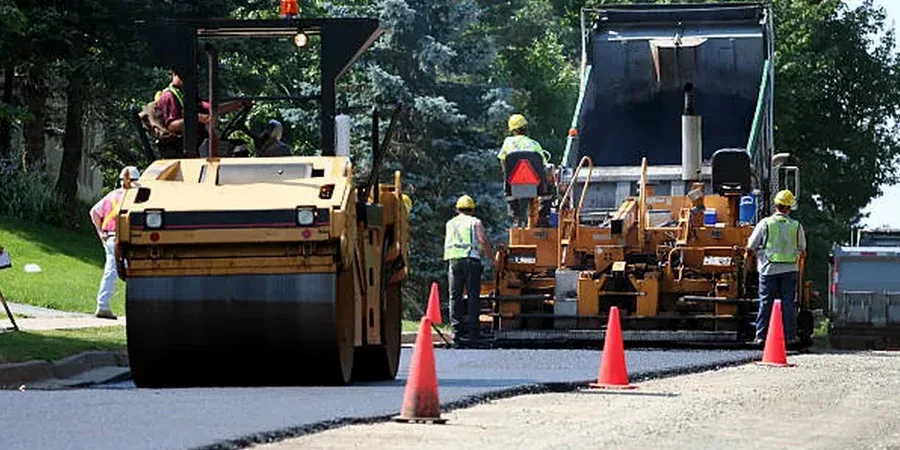
Canadian and Ontario standards govern all road geotechnics work in Barrie through a framework that ensures consistency and safety. The Ontario Ministry of Transportation's OPSS.MUNI 206 and OPSS 501 specify granular base, subbase, and subgrade requirements, while the Canadian Foundation Engineering Manual provides fundamental design principles. Pavement structural design typically follows the AASHTO 1993 method adapted to Ontario conditions, with MTO's Pavement Design and Rehabilitation Manual offering region-specific inputs for frost susceptibility and resilient modulus. All field and laboratory testing must comply with ASTM and CSA standards, including grain size analysis per ASTM D422, Proctor compaction per ASTM D698, and CBR testing per ASTM D1883. For rigid pavement design, additional considerations from the Cement Association of Canada and MTO's rigid pavement supplement apply, particularly regarding joint detailing and dowel bar placement in frost-active soils.
The range of projects requiring road geotechnics in Barrie spans from greenfield suburban developments in the annexed Innisfil lands to rehabilitation of aging arterial roads like Essa Road and Yonge Street. Municipal reconstruction projects often expose legacy fill materials, organic deposits, or undocumented utilities that demand geotechnical troubleshooting during construction. Industrial park expansions and commercial site servicing require pavement design reports sealed by a professional engineer, integrating geotechnical findings with stormwater management and grading plans. Transportation infrastructure near Lake Simcoe also triggers slope stability assessments and erosion protection measures where roadways parallel the shoreline or cross ravine systems. Each project type relies on accurate CBR study for road design data to calibrate pavement thickness and select appropriate subgrade treatment strategies such as lime stabilization or geogrid reinforcement.
Common questions
What does road geotechnics cover beyond just soil testing?
Road geotechnics encompasses the full spectrum of earth-related inputs to pavement design and construction: subgrade evaluation, bearing capacity assessment, frost susceptibility classification, drainage analysis, slope stability, and material specification for fills and granular layers. It also includes construction-phase verification through proof rolling, density testing, and subgrade inspection to confirm that design assumptions translate into field reality.
Why are geotechnical investigations critical for roads in Barrie specifically?
Barrie's glacial geology produces highly variable soils across short distances, from soft compressible clays near the bay to dense sandy tills in upland areas. Deep frost penetration, high groundwater, and freeze-thaw cycles subject pavements to severe seasonal stresses. Without site-specific geotechnical data, designs risk underestimating frost heave potential or overestimating subgrade strength, leading to early cracking and deformation.
What Ontario standards apply to road geotechnical work?
Ontario Ministry of Transportation specifications OPSS.MUNI 206 for granular materials and OPSS 501 for compaction govern construction. Design follows MTO's Pavement Design and Rehabilitation Manual, which adapts the AASHTO 1993 method to local climate and soils. Laboratory testing adheres to ASTM and CSA standards, while the Ontario Building Code references the Canadian Foundation Engineering Manual for broader geotechnical principles.
How does soil type influence the choice between flexible and rigid pavement in Barrie?
Weak, frost-susceptible subgrades like the silty clays common in Barrie often favor flexible pavements because they tolerate minor differential movements better and are easier to rehabilitate incrementally. However, rigid pavements may be selected for high-traffic corridors or industrial areas where long-term durability outweighs higher initial cost, provided the subgrade is adequately stabilized and a robust granular base layer is installed to mitigate pumping and frost effects.