Barrie's rapid expansion from a modest railway junction into one of Ontario's fastest-growing urban centres has pushed development into areas where excavation support is anything but routine. The city sits perched along Kempenfelt Bay, and the interplay between glacial till, stratified drift, and the water table barely a few metres below grade means that even a three-level underground parking structure demands careful geotechnical choreography. The design team working on deep excavation projects across Barrie regularly encounters lenses of silt and sand that behave differently under load than the stiff clay till that dominates the region, and understanding this layering before shoring design begins is what separates a predictable construction sequence from a reactive one. For sites within a kilometre of the lake, where the hydrostatic pressure shifts seasonally, the in-situ permeability testing we perform directly feeds into the dewatering plan and influences whether secant piles, soldier beams, or diaphragm walls become the most practical support system for the excavation perimeter.
In Barrie's glacially overconsolidated soils, the lateral stresses locked into the till can exceed what textbook at-rest coefficients predict, and missing that in the shoring design leads to wall deflections that nobody wants to explain to the adjacent property owner.
Process overview
Local context
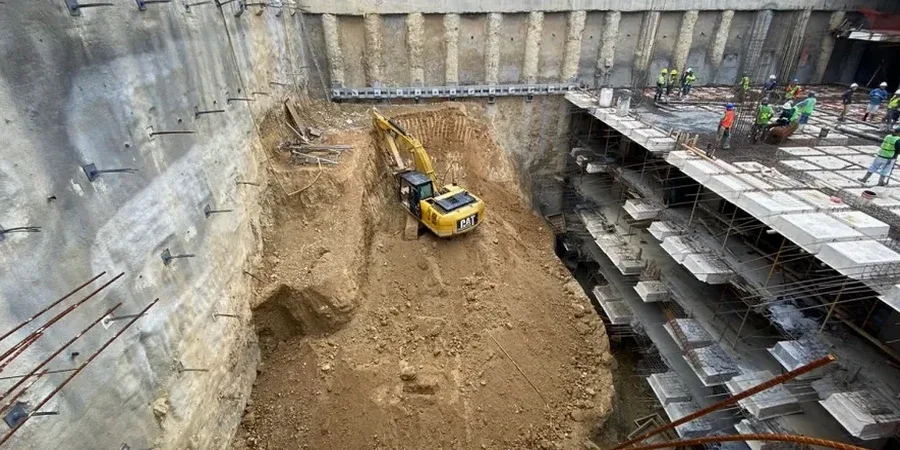
The contrast between a site up on the Ardagh Bluffs and one down in the Allandale neighbourhood illustrates why deep excavation design in Barrie is never a copy-paste exercise. Up on the bluffs, the overconsolidated Halton Till can stand almost vertically for short durations, and the main concern is managing surface runoff and preventing tension cracks from opening behind the shoring wall. Down near the Allandale GO Station, within the former lakebed plain, the stratigraphy shifts to interbedded silts and fine sands that lose strength rapidly when saturated, and the water table is often encountered at less than two metres. Here, a bottom heave failure during excavation is a genuine risk, and the global stability analysis must account for the softened toe conditions that develop once pumping begins. The team models both short-term undrained behaviour and long-term drained conditions because a support system that is stable during the six-month construction window can still creep toward failure over the following two years if the permanent drainage path is not properly designed.
Relevant standards
NBCC 2020 (National Building Code of Canada – Part 4), CSA A23.3-19 (Design of Concrete Structures – retaining wall provisions), Canadian Foundation Engineering Manual (CFEM) 4th Edition – deep excavation chapter, ASTM D7181-20 (consolidated drained triaxial compression test), OPSS.MUNI 206 (Ontario Provincial Standard – temporary shoring)
Additional services
Shoring Wall Design and Global Stability Analysis
We develop soldier pile and lagging, secant pile, or diaphragm wall designs matched to the stratigraphy logged at the specific site, incorporating staged excavation sequencing and pre-loading of tiebacks or internal bracing where space constraints dictate. Every analysis includes a basal heave check under undrained conditions and a global factor of safety assessment using limit equilibrium methods that account for the softened shear strength at the excavation toe after dewatering.
Dewatering and Pore Pressure Management Plans
For excavations that extend below the water table—particularly in the Allandale corridor and near the bay—we design dewatering systems ranging from sump pumping in low-permeability till to deep well systems with vacuum assistance in stratified silts. The plan includes drawdown predictions, settlement influence zones for adjacent structures, and monitoring trigger levels that align with the City of Barrie's permit requirements for groundwater discharge.
Typical parameters
Top questions
What is the typical cost range for geotechnical design of a deep excavation in Barrie?
Professional fees for the complete geotechnical design package—including site investigation interpretation, shoring wall design, dewatering plan, and construction-phase review—typically fall between CA$2,830 and CA$10,800 depending on the excavation depth, the complexity of the ground profile, and the number of adjacent structures requiring settlement analysis. A straightforward three-level excavation in competent till will sit at the lower end, while a five-level excavation with tiebacks and heritage-adjacent monitoring requirements will move toward the upper bound.
How does the Halton Till affect deep excavation design differently than the soils in the Toronto area?
The Halton Till in the Barrie region is geologically younger than the Sunnybrook and Scarborough tills found further south, and it tends to be less fissured but carries significant in-situ horizontal stresses from glacial loading and unloading. This means that while its intact undrained shear strength can be quite high—often above 100 kPa—the stress relief during excavation can trigger progressive softening along pre-existing micro-fractures. Our design approach includes a sensitivity analysis on the operational strength parameters, reducing the peak values obtained from triaxial testing by a factor that reflects the scale of the exposed face and the anticipated exposure duration.
Is a dewatering permit always required for deep excavations in Barrie?
Not always, but for any excavation that extends more than one metre below the static water table and requires continuous pumping during construction, the City of Barrie and the Lake Simcoe Region Conservation Authority will typically require a Permit to Take Water (PTTW) through the Ontario Ministry of the Environment, Conservation and Parks. The trigger is the volume of water discharged per day, and the application must demonstrate that the drawdown cone will not adversely affect neighbouring wells, surface water features, or the ecological function of nearby wetland areas. We prepare the hydrogeological supporting documentation as part of the dewatering design package.
What level of ground movement can be expected during a deep excavation in downtown Barrie?
Lateral wall deflections in Barrie's stiff till typically range between 0.1% and 0.3% of the excavation depth when a well-designed shoring system with pre-loaded tiebacks or bracing is used, though sites with softer silt layers near the base can see movements closer to 0.5%. The settlement influence zone behind the wall generally extends to a distance of about one to two times the excavation depth, and within the first half of that zone, settlements can reach 0.1% to 0.2% of the depth. We provide a calibrated ground movement prediction report using finite element modelling that the contractor can use to establish pre-construction condition surveys and monitoring trigger levels.
How do you handle excavation support on sites immediately adjacent to existing buildings in Barrie's older neighbourhoods?
For zero-lot-line excavations adjacent to century-old masonry structures—common along Dunlop Street and the surrounding blocks—we typically specify a secant pile wall or a contiguous pile wall with a reinforced shotcrete facing, combined with a limited number of pre-loaded tiebacks or internal rakers if the adjacent property owner will not grant an easement. The design includes a detailed building condition assessment protocol, vibration limits for pile installation, and a real-time monitoring program using inclinometers, crack gauges, and survey prisms. The allowable wall deflection is tightened to H/400 or 25 mm, whichever is smaller, to protect the brittle finishes of heritage masonry.