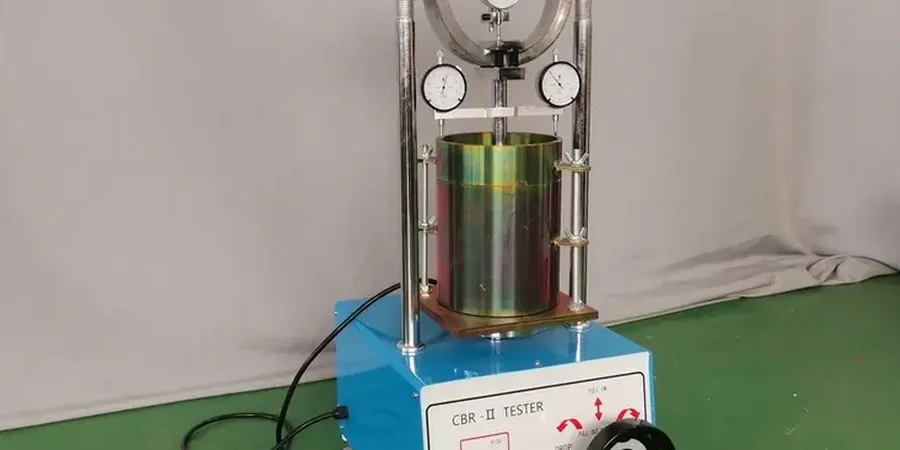
Barrie sits at roughly 252 meters above sea level, where the Kempenfelt Bay basin meets glacial till plains. That elevation shift matters when you're laying down a new subdivision road or commercial lot. Frost action and spring thaw turn marginal subgrades into a liability if the bearing ratio hasn't been verified. Our laboratory runs the California Bearing Ratio test under ASTM D1883, giving design engineers the soaked and unsoaked values they need to size pavement sections correctly. We see a lot of silty sand with pockets of clay across the south-end developments, and standard compaction alone doesn't tell the whole story. Pairing the CBR test with a Proctor compaction curve is the fastest way to nail down a target density that actually holds up under traffic loading.
A soaked CBR value below 3% in Barrie's silty subgrades usually means you're looking at a lime stabilization strategy, not just a thicker granular base.
Process overview
Local context
The contact between the Kempenfelt delta sand and the underlying glaciolacustrine silt creates a perched water table across several low-lying areas in Barrie, especially near the waterfront and along the Lovers Creek corridor. We have pulled samples in April that were nearly saturated at the surface, and the 96-hour soak test still knocked another 2 points off the CBR. That drop is the difference between a Section 300 granular base that works and one that rutts within two freeze-thaw cycles. Road designers working under MTO's flexible pavement design method rely on soaked CBR values to select the granular base equivalency, and underestimating moisture sensitivity leads to premature fatigue cracking. If the subgrade CBR comes back below 5% soaked, the pavement structural number demands jump significantly, and we flag the project for a liquefaction assessment if the water table is within the Zone A seismic depth defined by the Ontario Building Code.
Visual overview
Relevant standards
ASTM D1883-21: Standard Test Method for California Bearing Ratio (CBR) of Laboratory-Compacted Soils, ASTM D698-12: Standard Test Methods for Laboratory Compaction Characteristics of Soil Using Standard Effort, MTO LS-700: Ontario Laboratory Testing Manual – CBR Procedure
Additional services
Soaked CBR with Swell Measurement
Four-day immersion under 4.54 kg surcharge with continuous swell readings. The test replicates spring thaw conditions when the water table rises and the pavement structure is at its weakest.
Multi-Point CBR Curve
Three compaction points at 90%, 95%, and 100% of maximum dry density to build the full CBR-moisture relationship. Essential for value-engineering the pavement section when imported granular is expensive.
Rapid Turnaround for Construction QC
For active Barrie subdivisions where the grader is waiting on compaction acceptance, we prioritize unsoaked CBR results within 48 hours, followed by the full soaked report within the week.
Typical parameters
Top questions
What is the difference between soaked and unsoaked CBR, and which one matters for Barrie projects?
Unsoaked CBR measures the bearing ratio of a compacted sample at its molding moisture content. Soaked CBR submerges the specimen for 96 hours to simulate the worst-case moisture condition after construction. In Barrie, where the frost line reaches about 1.2 meters and spring melt saturates the upper subgrade, the soaked value governs pavement design. MTO flexible pavement design method explicitly requires the soaked CBR for subgrade characterization, and we report both values so the geotechnical engineer can assess moisture sensitivity.
How much does a laboratory CBR test cost in Barrie?
A standard single-point CBR test with compaction curve and 96-hour soak runs between CA$180 and CA$300 per sample, depending on whether you need a one-point or three-point compaction curve. Volume pricing applies for subdivision projects with more than ten samples.
How long does it take to get CBR results from your Barrie lab?
For an unsoaked CBR, we can turn results around in 48 hours from sample receipt. The full soaked CBR with swell measurement requires the 96-hour immersion period plus testing time, so expect a final report within 6 to 7 business days. We can split the reporting if you need the compaction curve and unsoaked data sooner for initial go/no-go decisions on fill placement.
What sample size do you need for a CBR test, and how should it be delivered?
We need a minimum of 25 kg of representative material in sealed plastic bags to prevent moisture loss. For Shelby tube samples from cohesive subgrades, one undisturbed tube per test point is sufficient. Samples should be labeled with the project name, station, and depth. If the material contains particles larger than 19 mm, we may need to run a CBR on the minus 19 mm fraction or use a larger mold, depending on the gradation.
Can you test granular base and sub-base materials, or just subgrade soils?
We run CBR tests on all pavement materials: subgrade, select subgrade, granular B, and granular A. For coarse granular with particles up to 37.5 mm, we use the 152.4 mm diameter CBR mold per ASTM D1883. The procedure is identical in principle, but the larger mold accommodates the bigger aggregate without scalping. We see the highest CBR values from the crushed dolostone aggregates sourced locally in Simcoe County, often exceeding 80% unsoaked.