In the realm of geotechnical engineering, ground improvement encompasses a suite of techniques designed to enhance the physical properties of soil and weak geological deposits, rendering them capable of safely supporting structural loads. For the city of Barrie, Ontario, this category is not merely a construction option but a fundamental necessity dictated by the region's challenging subsurface conditions. The overarching goal is to mitigate risks such as excessive settlement, bearing capacity failure, and liquefaction, thereby ensuring the longevity and safety of infrastructure. By altering soil characteristics like density, shear strength, and permeability, ground improvement provides a cost-effective and technically sound alternative to deep foundations, transforming marginal land into viable building sites for residential, commercial, and municipal projects.
Barrie's geological setting is dominated by the legacy of glacial Lake Algonquin, which has left behind a complex stratigraphy that directly drives the need for specialized ground improvement. The surficial geology is characterized by thick sequences of soft, compressible silty clays and loose, water-saturated sands, most notably within the extensive oro-moraine and lacustrine plain deposits. These soft clay layers are notorious for long-term consolidation settlement under load, while the loose saturated sands present a high risk of liquefaction during seismic events. This challenging environment means that conventional shallow foundations are frequently inadequate, demanding a proactive approach to soil treatment before any major construction can commence.
Any ground improvement project in Barrie must strictly adhere to the regulatory framework established by the Ontario Building Code (OBC), which directly references national standards. The design and execution of these techniques are governed by the Canadian Foundation Engineering Manual (CFEM) and relevant CSA standards. Furthermore, a comprehensive geotechnical investigation conforming to the Ministry of Transportation's (MTO) guidelines is a non-negotiable prerequisite for any design. The work must be performed under the supervision of a licensed Professional Engineer (P.Eng.) in Ontario, who is responsible for validating the design parameters, overseeing field trials, and certifying that the completed improvement meets the specified performance criteria, particularly for settlement and bearing capacity.
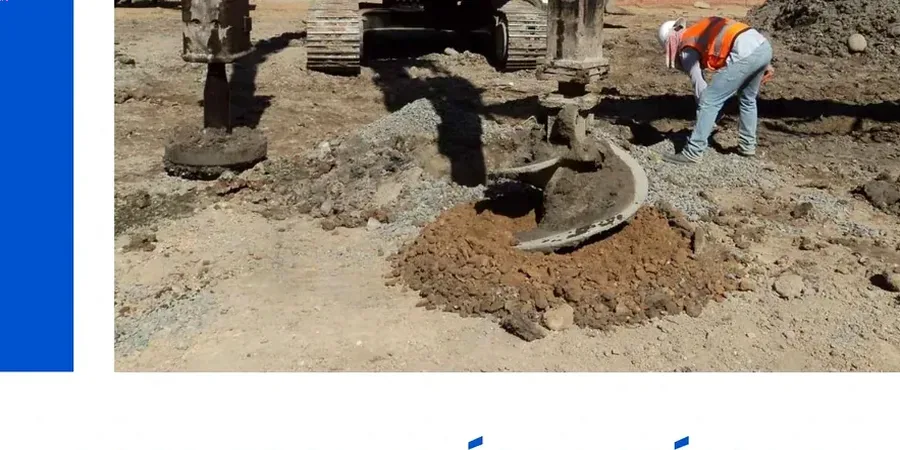
The types of projects in Barrie requiring ground improvement are diverse, ranging from infrastructure expansions to new urban developments. The construction of low-rise residential subdivisions often triggers the need for treatment of the compressible clay plain to prevent differential settlement. For heavier commercial structures, such as big-box stores, or industrial warehouses with high floor loads, advanced solutions like stone column design are frequently specified to reinforce the soft soils and accelerate drainage. Similarly, for infrastructure corridors, bridge approaches, and high-rise condominiums where loose granular soils pose a liquefaction threat, vibrocompaction design becomes a critical technique to densify the ground in-situ and eliminate the risk.
Available services
Common questions
Why is ground improvement so critical for construction projects in Barrie, Ontario?
Barrie's subsurface is largely composed of soft, compressible silty clays and loose sands deposited by ancient glacial Lake Algonquin. These native soils are prone to excessive long-term settlement and liquefaction. Ground improvement techniques are essential to engineer these weak deposits, increasing their strength and stability to safely support structural loads without the cost and complexity of deep pile foundations.
What are the primary geotechnical goals of a ground improvement program?
The main objectives are to increase bearing capacity, minimize total and differential settlements, and mitigate the risk of soil liquefaction during an earthquake. Other goals can include accelerating the consolidation of soft clays, reducing lateral earth pressures on retaining structures, and improving the overall stiffness of the soil mass to meet specific project performance criteria.
Which Ontario building codes and standards govern ground improvement work?
Ground improvement in Barrie is governed by the Ontario Building Code (OBC), which mandates design in accordance with the Canadian Foundation Engineering Manual (CFEM) and relevant CSA standards. A licensed Professional Engineer (P.Eng.) must oversee the design, which must be based on a thorough geotechnical investigation, and is responsible for certifying that the treated ground meets all specified performance requirements.
How is the effectiveness of a ground improvement technique verified after construction?
Verification is a critical phase involving a combination of in-situ testing and monitoring. Common methods include Standard Penetration Tests (SPT), Cone Penetration Tests (CPT), pressuremeter tests, and full-scale load tests on treated ground. The results are directly compared to the pre-construction conditions and the project's design criteria to confirm that the required improvement in density, strength, and stiffness has been achieved.