A mid-rise residential project along Essa Road encountered more than six meters of compressible organic silt over glacial till, a profile that repeats across many Barrie sites near the former Lake Algonquin plain. The structural loads required Improvement capable of limiting total settlement to under 25 mm while avoiding the cost and vibration risk of driven piles in a neighborhood with heritage homes. The design team specified an array of vibro-replacement stone columns penetrating the soft layer and bearing on the competent till below, achieving a composite ground stiffness that kept differential movements within NBCC serviceability limits. For projects where the compressible zone extends deeper, we often combine the stone column layout with CPT soundings to map the precise depth to refusal and refine the column length grid by grid.
In Barrie's post-glacial clays, a well-designed stone column grid can reduce settlement by 60 percent or more while accelerating consolidation through radial drainage.
Process overview
Local context
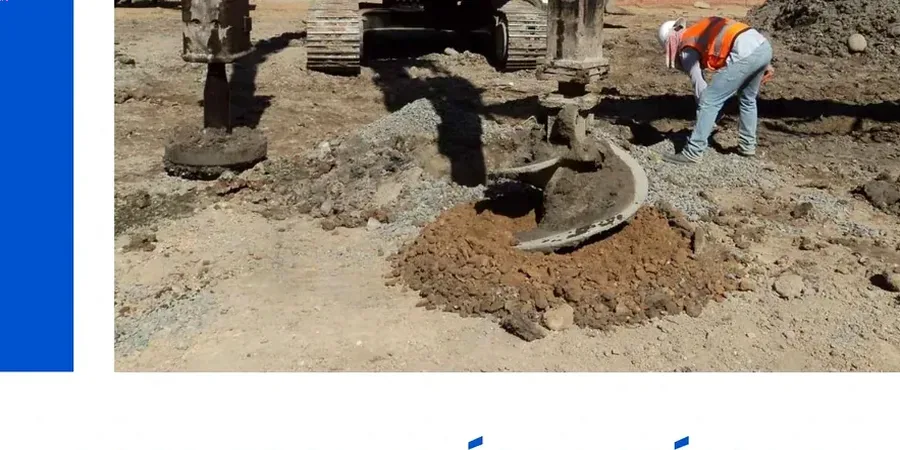
A hydraulic vibroflot with a 130 kW power pack hangs from a crawler crane on a Barrie jobsite, its cylindrical probe vibrating at 30 to 50 Hz as it penetrates the soft silt under its own weight and water jet assist. Stone is fed from a loader bucket into the annular space around the probe, and each lift is compacted in roughly one-meter increments until the column reaches the design top elevation. The crew monitors amperage, penetration rate, and stone consumption in real time; a sudden drop in backfill take can indicate cavity formation in organic pockets, requiring immediate adjustment of feed rate or a switch to bottom-feed technique. Nearby slopes, such as those along the Lovers Creek ravine, demand careful sequencing so that vibration does not trigger a rotational failure before the columns mobilize shear strength. Post-installation verification includes modulus load tests on selected columns and, when column interaction is critical, a full-scale zone load test.
Relevant standards
NBCC 2015 – Structural Commentaries (Foundation Design), ASTM D698 / D1557 – Aggregate compaction characteristics, ASTM D5778 – CPT for stratigraphic profiling, FHWA-NHI-16-009 – Improvement Methods
Additional services
Geotechnical Site Characterization
Cone penetration testing and borehole sampling through the compressible layer to define thickness, undrained shear strength, and preconsolidation pressure at the Barrie project location.
Unit Cell and Group Analysis
Axisymmetric finite element or closed-form modeling using Priebe or Balaam–Booker methods to establish column spacing, diameter, and length for the target settlement criterion.
Construction Monitoring and Load Testing
On-site supervision during vibro-replacement installation, real-time parameter logging, modulus tests on individual columns, and zone load tests for critical foundation elements.
Typical parameters
Top questions
What is the typical cost range for stone column design and installation in Barrie?
For a typical residential or light commercial project in Barrie, the complete engineering design and construction-phase oversight for stone columns generally ranges from CA$2,140 to CA$7,860, depending on the number of columns, depth of the soft layer, and the extent of load testing required.
How does stone column design account for Barrie's post-glacial clay deposits?
The design uses site-specific undrained shear strength and consolidation parameters obtained from CPT and laboratory testing. Because Barrie's clays often exhibit slight overconsolidation from desiccation, we apply a preconsolidation pressure correction in settlement calculations and check short-term stability during installation using total stress analysis.
Can stone columns be used near existing structures in downtown Barrie?
Yes, but careful sequencing and vibration monitoring are essential. We specify a minimum standoff distance based on soil type and building condition, and often install a row of columns as a vibration barrier before working closer to sensitive structures. Pre- and post-condition surveys are standard practice on these urban sites.