The difference between building in south-end Barrie near the Lovers Creek floodplain and a project up in the Ardagh Bluffs is night and day, and the soil tells that story immediately. You might be dealing with dense glacial till in one spot and soft, compressible silty clay just half a kilometer away. A thorough soil mechanics study connects raw site data with the structural demands of the Ontario Building Code, giving you a clear picture of bearing capacity, settlement, and drainage before a single footing is poured. Our lab team runs the full suite of index and strength tests so the numbers on the report reflect exactly what the contractor will encounter during excavation, not a generic regional assumption.
In Barrie's glacial terrain, the difference between a stiff till and a soft clay lens can be less than two meters horizontally—skip the soil mechanics study and you are gambling with your foundation.
Process overview
Local context
A mistake we see repeatedly in Barrie is treating the entire site like one soil type because the top 300 millimeters look uniform during a walk-around. Builders skip the soil mechanics study, pour footings on what they assume is competent sand, and then discover a buried organic silt layer when the floor slab cracks six months later. Organic soils compress unevenly under load, and in Barrie's low-lying areas near Kempenfelt Bay, they are more common than most contractors want to admit. Without consolidation data and shear strength parameters, the structural engineer is forced to use conservative assumptions that either inflate the foundation cost or underestimate differential settlement. The lab results answer the question definitively, and that answer costs a fraction of what litigation and underpinning will run you down the road.
Visual overview
Relevant standards
ASTM D2487-17e1 (USCS classification), ASTM D4318-17e1 (Atterberg limits), CSA + ASTM D2850 (Unconsolidated-undrained triaxial), CSA A23.3-19 (Concrete structures — subgrade reference), Ontario Building Code (O. Reg. 332/12, Div. B, Part 4)
Additional services
Full Laboratory Index & Strength Testing
From moisture content and grain-size distribution to consolidated-undrained triaxial tests, every specimen is prepared and tested according to ASTM standards. We run Atterberg limits on all fine-grained samples, because Barrie's varved clays can show plasticity indices above 30%—a detail that changes slab-on-grade design entirely.
Field Sampling & Borehole Logging Support
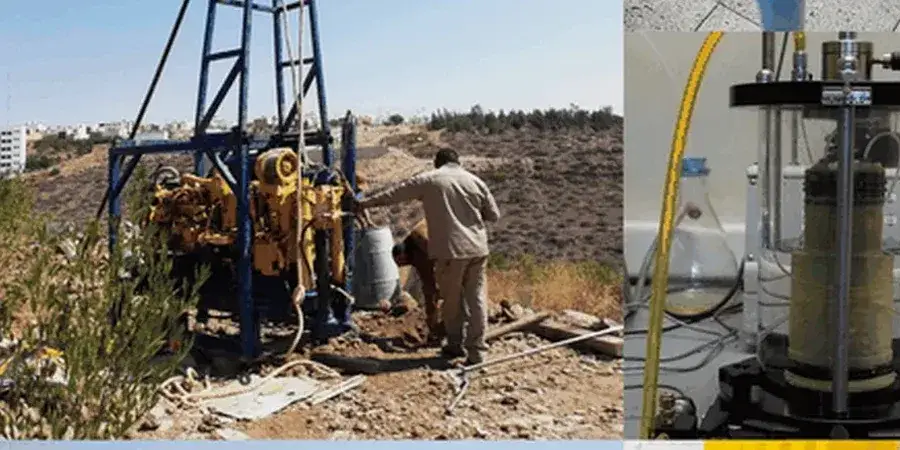
We coordinate directly with drilling crews operating across Simcoe County to ensure Shelby tubes and split-spoon samples arrive in the lab undisturbed. Our technicians prepare detailed borehole logs with USCS classification and field moisture estimates, giving the geotechnical engineer a reliable subsurface profile from the first day of investigation.
Typical parameters
Top questions
What does a soil mechanics study in Barrie typically cost for a single-family home project?
For a standard residential lot in Barrie, a complete soil mechanics study with borehole sampling, lab index testing, and a geotechnical report generally ranges from CA$4,300 to CA$7,540. The final figure depends on the number of boreholes required, depth to bedrock, and whether advanced tests like triaxial or consolidation are specified by the design engineer.
How deep do you need to investigate for a soil mechanics study in Barrie?
It depends on the foundation type and the loads, but for most residential and low-rise commercial projects in Barrie, boreholes go to 6 or 8 meters minimum. If we encounter the glacial till early, the investigation confirms refusal and stops; if we hit the soft varved clay sequence common near the lake, we often go deeper to evaluate consolidation and long-term settlement.
Which ASTM standards apply to the laboratory tests?
The core standards we use in every Barrie soil mechanics study are ASTM D2487 for classification, ASTM D4318 for Atterberg limits, ASTM D6913 for sieve analysis, and CSA + ASTM D2850 or D4767 for triaxial compression. Consolidation testing follows CSA + ASTM D2435, and all procedures are covered under our ISO 17025 scope of accreditation.
How long does it take to get the final report after sampling?
Simple projects with standard index tests can turn around in 7 to 10 business days. When the soil mechanics study requires consolidation or triaxial testing with staged loading, the lab work alone takes two to three weeks, so the full report typically lands in your inbox within four weeks from the drilling date.