The surficial geology beneath Barrie is dominated by the complex stratigraphy of the former glacial Lake Algonquin plain, where thick sequences of glaciolacustrine silt and clay interbed with sandy till. These fine-grained deposits, prevalent across the city’s expanding south-end subdivisions and the older bayside neighborhoods near Kempenfelt Bay, are highly sensitive to changes in moisture content. The engineering behavior of these soils cannot be inferred from grain size alone; their plasticity dictates how they will react to seasonal freeze-thaw cycles and imposed structural loads. When foundation designs must account for frost heave potential or long-term settlement, the Atterberg limits test provides the quantitative threshold values—liquid limit, plastic limit, and the derived plasticity index—that distinguish a stable stiff clay from a problematic soft silt. In a region where the water table often sits high within the sandy aquifers of the Oro Moraine, understanding these consistency limits prevents costly over-excavation or, worse, under-design of subgrade layers. The team integrates these index properties with broader geotechnical assessments, often supplementing the classification with a detailed Proctor compaction evaluation to verify that the native Barrie clay can achieve the specified density under mechanical compaction efforts.
Plasticity is the soil’s fingerprint in the Barrie region—ignoring the liquid limit of a glaciolacustrine clay is a direct path to differential heave and structural distress.
Process overview
Local context
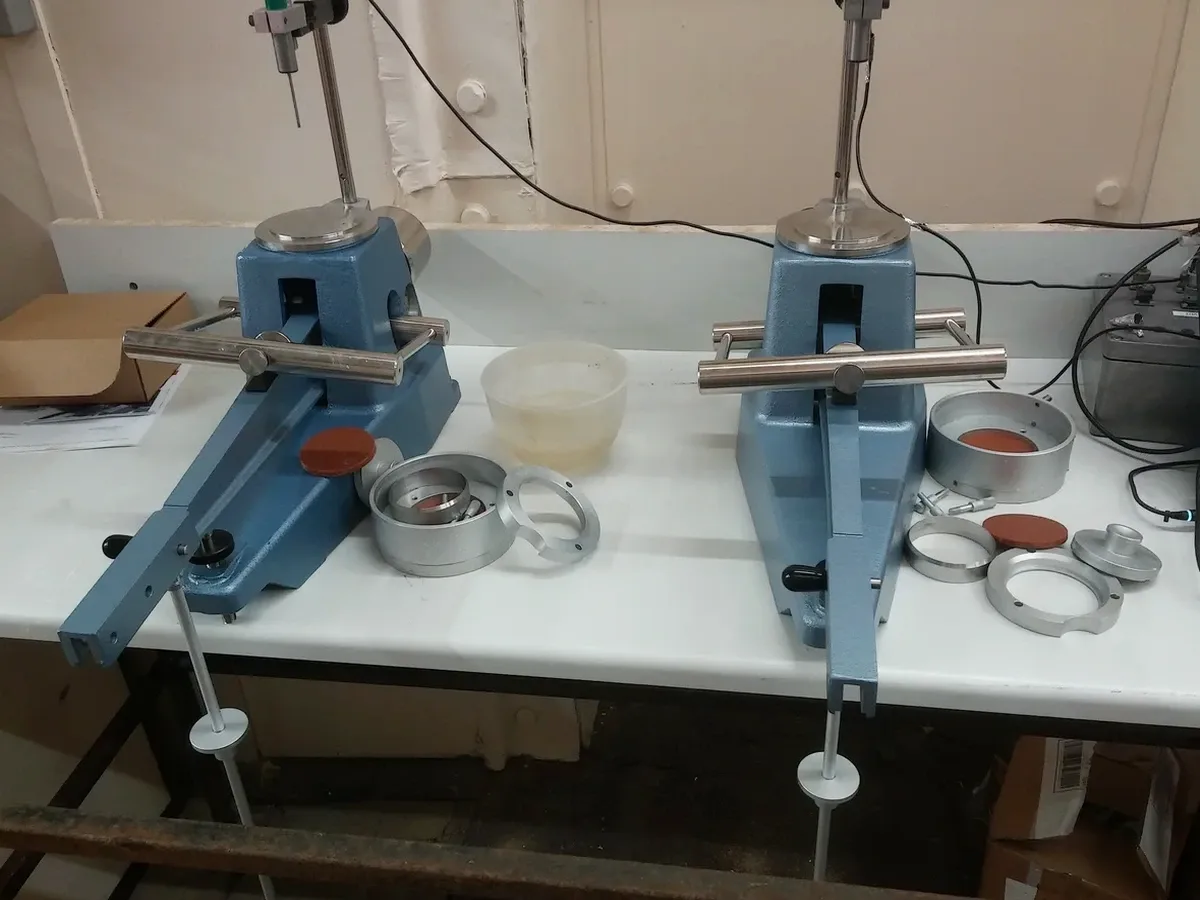
The classic Casagrande cup apparatus, while conceptually simple, demands a careful operator to avoid the systematic errors that plague Atterberg determinations on Barrie’s sensitive clays. The grooving tool must cut a clean 2 mm-wide channel through the soil paste without tearing the clay fabric, and the crank must deliver a perfectly consistent drop rate of 1.9 to 2.1 blows per second. When testing the varved clays common near the Lovers Creek tributary, the laminations of silt and clay can trigger premature closure of the groove, artificially lowering the liquid limit result by several percentage points. A technician who rushes the rolling-thread test will typically underestimate the plastic limit by stopping at a diameter greater than 3 mm, leaving excess water in the sample and yielding a falsely low plasticity index. Such laboratory artifacts translate directly into misclassified subgrades on the construction drawings. A clay mistakenly logged as low-plasticity silt will be treated as free-draining select fill rather than a frost-susceptible material requiring sub-excavation and granular replacement, creating a latent defect that manifests only after the first winter heave cycle cracks the asphalt or displaces a shallow footing.
Relevant standards
ASTM D4318-17e1: Standard Test Methods for Liquid Limit, Plastic Limit, and Plasticity Index of Soils, ASTM D2487-17e1: Standard Practice for Classification of Soils for Engineering Purposes (Unified Soil Classification System), CSA A23.3: Design of Concrete Structures (referenced for foundation design inputs derived from index properties), MTO LS-703: Ministry of Transportation Ontario Method for Determination of Liquid Limit (harmonized for provincial infrastructure)
Additional services
Full Atterberg Limits Determination (LL, PL, PI)
Multipoint liquid limit test using the Casagrande percussion method with a minimum of four data points per sample, plus plastic limit determination by the rolling-thread technique. The report includes the calculated plasticity index, liquidity index, and USCS classification group symbol, with commentary on expected volume change potential and frost susceptibility for the subject soil.
One-Point Liquid Limit & Field Verification
A rapid single-point liquid limit test calibrated against the established flow curve for homogeneous soil units. This service is used during construction to confirm that excavated clay borrow material still conforms to the project specification limits, providing same-day results for earthworks quality assurance on large-scale Barrie residential developments.
Typical parameters
Top questions
How much does Atterberg limits testing cost for a typical Barrie residential lot?
For a standard residential project requiring classification of one or two samples from a test pit or borehole, the testing fee generally ranges from CA$100 to CA$140 depending on whether a full multipoint liquid limit or a single-point verification is sufficient. The final amount depends on the number of samples and the required turnaround time.
What is the minimum sample mass required to run the Atterberg limits in the laboratory?
The ASTM D4318 method requires a representative specimen of approximately 150 to 200 grams of soil passing the No. 40 (425 µm) sieve. This material must be obtained from a thoroughly homogenized sample of the fine-grained stratum of interest, and it should be kept in an airtight container to preserve the natural moisture content if field conditions are also being evaluated.
Can the Atterberg limits test distinguish between a true clay and a silt in the Barrie glacial deposits?
Yes, the plasticity index is the definitive criterion for this distinction. A soil with a PI above the A-line on the Casagrande plasticity chart is classified as a clay (CL or CH), while material plotting below the A-line is an ML or MH silt. In the Barrie context, many glaciolacustrine deposits appear clay-like in the hand but plot as silts due to a low dry strength, and the Atterberg limits provide the quantitative evidence to correctly assign the USCS symbol for structural design.