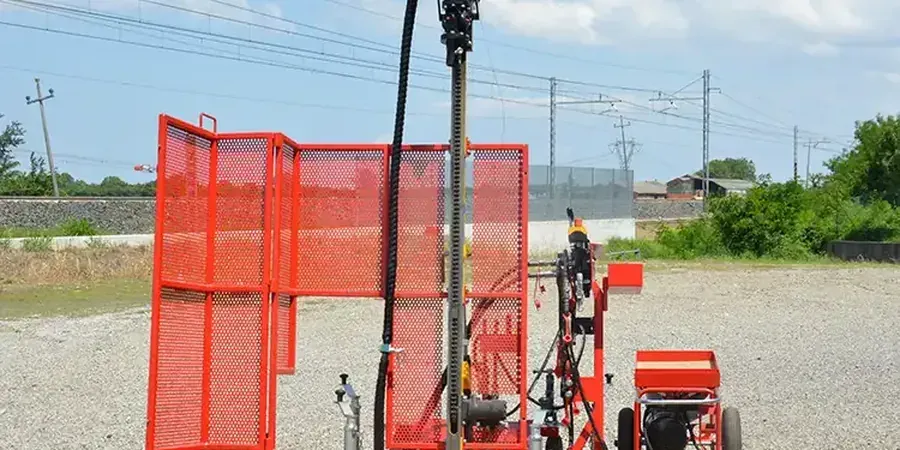
The rig we mobilize most often around Barrie is a truck-mounted CME-75 with an automatic trip hammer. It runs the 140-pound drive weight through a 30-inch drop, recording blow counts every six inches. Kempenfelt Bay and the western tablelands sit on a complicated stack of glacial till, sandy outwash, and pockets of glaciolacustrine silt. That variability means one borehole can show N=4 at nine feet and refusal at twenty-two. We pull continuous split-spoon samples in a 2-inch O.D. sampler, logging recovery, moisture, and color change as we go. When the stratigraphy gets erratic near the Oro Moraine, we often pair the SPT program with grain-size analysis to confirm the fines content that controls drainage behavior under footings. The rigs carry enough rod to push past 60 feet where required, and we calibrate hammer energy to ASTM D1586-18 before every campaign.
In Barrie, SPT refusal in the till is a welcome signal — it means you have found the bearing stratum that held up every arena and school built here since the 1970s.
Process overview
Local context
Barrie’s freeze-thaw cycle runs deeper than most Ontario cities — frost penetration here routinely reaches four feet, and the clay-rich till near the lake swells when it saturates in April. Skip the SPT program and you are guessing what sits below the frost line. We have seen slabs heave on undersized footings because the designer assumed medium-dense sand and got soft silt instead. The other risk is liquefaction in the loose saturated sands mapped along the old Lake Algonquin strandline. NBCC 2020 puts parts of Barrie in a moderate seismic zone, and SPT blow counts below 15 in saturated fine sand demand a follow-up screening. Even on small commercial builds, missing that data can trigger a stop-work order once the city’s geotechnical reviewer sees the borehole logs are thin. We run the test, correct to N60, and deliver a log that answers both bearing and seismic questions in a single afternoon of drilling.
Relevant standards
ASTM D1586-18 – Standard Test Method for Standard Penetration Test (SPT) and Split-Barrel Sampling of Soils, ASTM D2488 – Standard Practice for Description and Identification of Soils (Visual-Manual Procedure), NBCC 2020 – National Building Code of Canada, seismic provisions and Site Class determination, CSA A23.3 – Design of concrete structures, foundation requirements referencing SPT-based bearing values
Additional services
Deep SPT drilling with automatic hammer
We mobilize tracked or truck-mounted CME rigs across Simcoe County, running continuous SPT sampling at 5-foot intervals. Every split spoon is logged for recovery, color, moisture, and consistency. N-values are corrected to N60 on site, and we record groundwater at multiple depths. Typical depth range is 10 to 70 feet, covering the full overburden column down to competent till or bedrock.
Liquefaction screening and seismic site class
For sites inside Barrie’s NBCC seismic contour, we run SPT-based liquefaction assessment using the NCEER/Youd-Idriss method. Blow counts, fines content from lab grain-size, and groundwater depth feed into the analysis. The output is a Site Class letter and a factor of safety against liquefaction for each critical layer, ready for the structural engineer’s seismic design package.
Typical parameters
Top questions
What does an SPT program in Barrie cost for a typical residential lot?
For a standard single-family or small commercial lot in Barrie, a two-borehole SPT program with logging, groundwater observation, and a signed geotechnical report typically runs between CA$850 and CA$1,180, depending on depth and access. Deeper programs or difficult access near the waterfront may push toward the upper end of that range.
How many boreholes does the City of Barrie typically require for a new commercial build?
The city’s building department generally expects a minimum of three boreholes for commercial structures, spaced to cover the footprint corners. The exact number depends on the building size and soil variability. Our team reviews the site plan with the geotechnical engineer and positions the rig to capture the critical bearing stratum and any soft zones that need over-excavation.
Can SPT data alone determine if a Barrie site needs deep foundations?
SPT data is the primary tool for that decision. When N-values in the upper 15 feet stay below 10 and we are sitting on compressible silt or loose sand, the bearing capacity often falls below what shallow footings need. In those cases the N-values, combined with lab index testing, justify a recommendation for piles or Improvement. We have used SPT logs on hundreds of Barrie sites to make that call definitively.