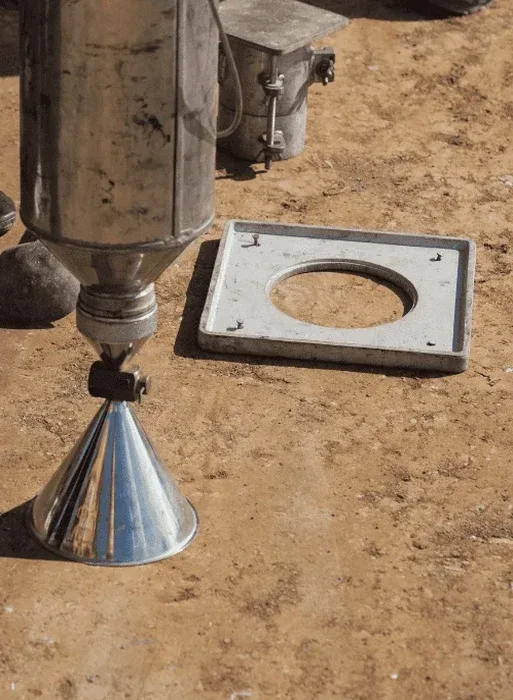
The metal base plate sits flat on the compacted lift, the rotary hammer having just bored a neat six-inch hole through the silty sand. In Barrie, where glacial Lake Algonquin left behind layered deposits of sand, silt, and clay, the sand cone apparatus becomes the most direct window into what a nuclear gauge can only infer. Our field crews set up the one-gallon jar, open the valve, and let Ottawa sand flow free-fall into the excavation, filling every void around the extracted material. The method follows ASTM D1556 and ASTM D1557, giving you a wet density number that ties directly back to the Proctor curve. For Barrie’s fast-growing south-end subdivisions and the industrial parks along Highway 400, this test provides the compaction data that city inspectors and geotechnical engineers need before the next lift goes down. When the subgrade is variable—transitioning from sand to stiff clay within fifty meters—the sand cone method paired with a Proctor test establishes the target density reference that governs acceptance.
A sand cone test on Barrie's silty sand can detect a 2 percent density deficit that a nuclear gauge masks due to moisture interference.
Process overview
Local context
Part 4 of the Ontario Building Code references CSA A23.1 for concrete and NBCC 2015 for structural design, but the compaction acceptance criteria for engineered fill often default to the project geotechnical specification—and in Barrie, that specification must account for frost susceptibility. Undetected low density in a trench backfill beneath a commercial slab in the north end can lead to differential settlement after two winters of frost heave, cracking the slab and compromising the building envelope. The sand cone test catches these under-compacted zones before the concrete goes in. Our team has documented failing densities in utility trenches where the contractor skipped a lift due to rain, assuming the gravel would self-compact; the sand cone showed 89 percent where 95 was required. In these cases, re-compaction combined with a follow-up in-situ permeability test confirmed that the soil structure was restored, preventing future water migration into the subgrade.
Relevant standards
ASTM D1556-15e1: Standard Test Method for Density and Unit Weight of Soil in Place by Sand-Cone Method, ASTM D1557-12e1: Standard Test Methods for Laboratory Compaction Characteristics of Soil Using Modified Effort, Ontario Building Code (O. Reg. 332/12), Part 4 references, OPSS.MUNI 501: Compacting Specifications for Municipal Infrastructure
Additional services
Compaction Verification for Engineered Fill
We perform sand cone density tests on structural fill beneath footings, floor slabs, and retaining wall backfill across Barrie's residential and commercial projects. Each test includes moisture content determination and percent compaction calculation against the laboratory Proctor control, with immediate field results and a sealed report for the building inspector.
Road Base and Utility Trench Density Testing
For municipal road reconstruction on streets like Bayfield and Essa Road, and for trench reinstatement under city permit, we provide density testing at specified intervals per lift. The sand cone method remains the referee test when nuclear gauge readings are disputed, particularly in the organic silts common near Barrie's creek corridors.
Typical parameters
Top questions
How much does a sand cone density test cost in Barrie?
A single field density test using the sand cone method in Barrie typically ranges from CA$140 to CA$220, depending on site access, number of tests per mobilization, and whether the project is within the city core or in outlying areas like Innisfil or Springwater. Volume discounts apply when multiple tests are scheduled on the same day.
How long does the sand cone test take on site?
A single test takes about 20 to 30 minutes from excavation to field moisture determination, assuming the technician can set up on an accessible, level surface. The complete report with laboratory-dried moisture content and final percent compaction is typically available within 24 hours, though rush turnaround can be arranged for same-day paving operations.
What soil types can the sand cone method handle in the Barrie area?
The method works well on the granular sands and silty sands found across Barrie, including the glaciolacustrine deposits south of the city. It is less suited to very soft, wet clays where the hole walls may collapse, or to soils with large gravel cobbles that distort the excavated volume. In those cases we may recommend alternative verification methods or proceed with extra care using a larger-diameter hole.
Is the sand cone test accepted by Barrie building inspectors?
Yes, ASTM D1556 is the standard reference method cited in most Ontario geotechnical specifications and is fully accepted by the City of Barrie's building services division and consulting engineers for compaction verification on engineered fill, road subgrade, and trench reinstatement. The test provides a direct measurement of in-place density, unlike indirect nuclear methods.