The Kempenfelt Bay basin left Barrie with a subsurface that can flip from dense glacial till to soft, compressible silty clay within a single push. Standard drilling tells you part of the story, but when you need a near-continuous profile of tip resistance and sleeve friction across these abrupt transitions, the cone penetration test is hard to beat. In our experience working along the Highway 400 corridor and the infill lots near the waterfront, CPT logs catch the thin sand lenses and sensitive clay layers that split-spoon sampling often misses. For geotechnical engineers dealing with the overconsolidated Newmarket Till and the underlying glaciolacustrine deposits, seismic refraction can complement the CPT by mapping the depth to bedrock across a site, while in-situ permeability helps quantify drainage through the interbedded sands.
A single CPT sounding in Barrie can cross three distinct glacial units — it's the continuous friction ratio that separates competent till from sensitive clay.
Process overview
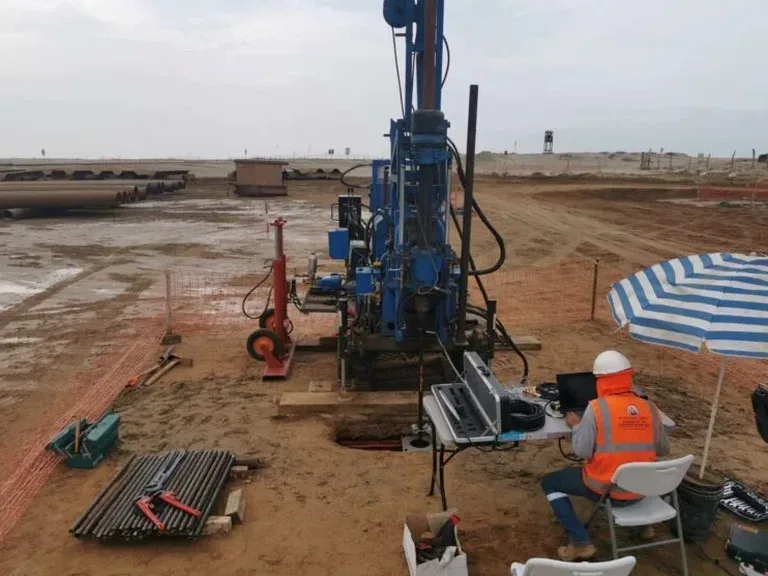
Local context
One thing we see repeatedly in Barrie's east-end subdivisions is a thin desiccated crust of stiff clay over softer, normally consolidated material. A CPT profile reads right through that crust and reveals the true bearing weakness below — something a shallow test pit might completely miss. The real risk is designing footings on the strength of the upper 1.5 meters without knowing what the cone resistance does at 3 or 4 meters. Over the years, the team has also encountered pockets of loose, saturated sand within the glacial sequence near the old Lake Algonquin shoreline; these show up as near-zero tip resistance and elevated pore pressure, a classic liquefaction-susceptible signature under seismic loading. Ignoring the CPT data in these transition zones can lead to differential settlement problems that are expensive to remediate once the framing is up.
Visual overview
Relevant standards
ASTM D5778-20 (Standard Test Method for Electronic Friction Cone and Piezocone Penetration Testing of Soils), NBCC 2020 (National Building Code of Canada — seismic site classification via Vs correlation), CSA A23.3-14 (Design of Concrete Structures — foundation bearing capacity evaluation), Robertson and Wride (1998) — CPT-based soil behavior type classification
Additional services
Piezocone (CPTu) Sounding with Pore Pressure
The standard for Barrie's fine-grained soils. We measure cone tip resistance, sleeve friction, and dynamic pore water pressure to identify the thin silt seams and clay layers that control consolidation settlement in the lacustrine deposits.
Seismic Cone (SCPTu) for Vs Profiling
By adding a geophone module, we capture shear wave velocity at 1-meter intervals. This data feeds directly into the NBCC site class determination and liquefaction assessment, particularly useful near the Simcoe County floodplains.
CPT Data Analysis and Geotechnical Reporting
We process the raw cone data through Robertson's soil behavior type charts and provide interpreted stratigraphic logs, equivalent SPT N60 values, and bearing capacity estimates correlated to the CPT tip resistance for your foundation engineer.
Typical parameters
Top questions
How deep can a CPT rig penetrate in Barrie's glacial till?
The dense Newmarket Till that covers much of Barrie can challenge even heavy CPT equipment. In most residential and commercial lots we reach depths of 15 to 25 meters before encountering refusal on cobbles or bedrock. For deep investigations near the bay, where the postglacial clay is thicker, 30-meter soundings are common. The actual refusal depth varies block by block, so we always recommend budgeting for a preliminary push to confirm local conditions.
What does a CPT test cost for a typical Barrie residential lot?
For a standard single-family lot in Barrie, a CPT sounding with piezocone typically falls in the CA$260 to CA$360 range per location, depending on depth achieved and mobilization distance. A basic package of three soundings for a small subdivision usually provides enough stratigraphic control for foundation design without breaking the budget.
Can CPT data give me the shear strength of the clay for a retaining wall design?
Yes. The net cone tip resistance correlates well with undrained shear strength (Su) in Barrie's glaciolacustrine clays through the standard cone factor Nkt. We determine the site-specific Nkt from a few parallel lab tests on thin-walled samples, then apply it across the entire CPT profile to get a continuous Su plot that retaining wall and slope stability analyses require.
Do I still need a borehole if I run CPT on my Barrie site?
CPT gives you a continuous geotechnical signature, but it does not retrieve soil samples. In our Barrie practice, the most solid investigations pair one or two boreholes with several CPT soundings — the borehole provides the ground truth for soil classification and lab testing, while the CPT fills in the gaps between boreholes at a fraction of the cost and time.