Base isolation seismic design in Barrie is governed directly by the National Building Code of Canada (NBCC 2020), which places the city within a moderate seismic hazard zone. Barrie sits on the western shore of Lake Simcoe, overlying a complex stratigraphy of glacial till, sand, and silt from the former Lake Algonquin. This geology amplifies ground motion in ways that conventional fixed-base design can underestimate. Our laboratory combines the NBCC site-specific spectral acceleration values with detailed MASW surveys to determine the actual Vs30 at the project location. The site class, often C or D across the city, becomes the foundation for selecting isolation bearing properties—effective stiffness, damping, and displacement capacity—so the superstructure remains elastic during a design-level event. Because Barrie’s population has grown beyond 150,000, critical facilities like the Royal Victoria Regional Health Centre and new mid-rise condominiums near the waterfront demand a higher performance level. We support the structural engineer by providing the geotechnical parameters that feed directly into the nonlinear time-history model, ensuring the isolation system complies with CSA S832, ASCE 7 Chapter 17, and the NBCC Part 4 requirements for post-disaster buildings.
In Barrie's glacial geology, a 0.2-second spectral acceleration of 0.35g can translate to 400 mm of isolator displacement if the site period isn't measured directly.
Process overview
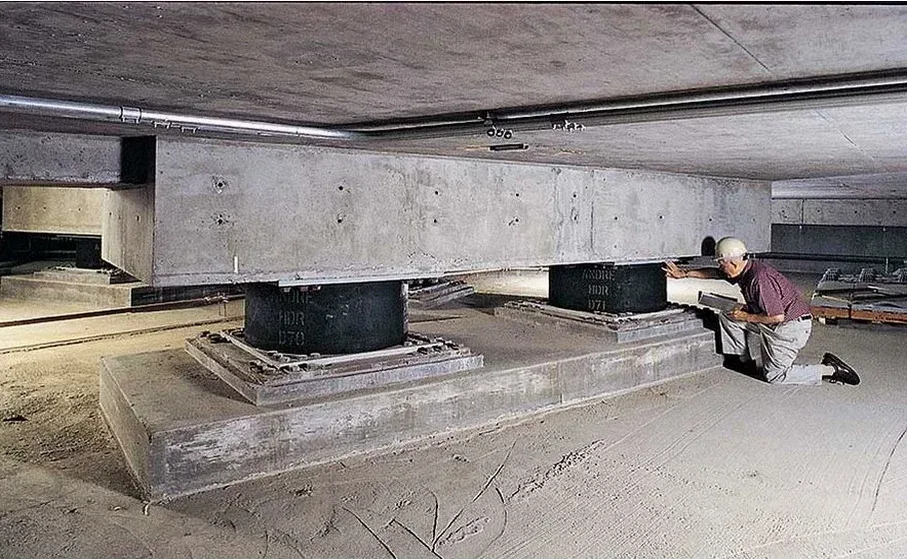
Local context
Barrie’s elevation ranges from roughly 175 meters near Kempenfelt Bay to over 300 meters in the southern uplands, creating abrupt changes in soil stiffness over short distances. A project on a buried sand channel can have a spectral acceleration Sa(0.2) 40% higher than one on dense till just 500 meters away. The most significant risk we see in isolation system design is using a generic site class without confirming the dynamic properties through field testing. If the design assumes firm ground but the reality is a soft clay pocket with a fundamental period close to the isolation period, the isolator displacement can double. The 2010 Val-des-Bois earthquake, though centered in Quebec, was felt strongly in Barrie and reminded local engineers that eastern Canadian seismicity is characterized by higher frequency content and longer duration than western events. Our lab mitigates this by running site response analyses with input motions matched to the 2% in 50-year uniform hazard spectrum for Barrie’s coordinates. We also verify that the liquefaction potential in the saturated sands near the lakefront is accounted for, since bearing capacity loss under an isolator would neutralize the isolation benefit.
Visual overview
Relevant standards
NBCC 2020 – Part 4, Structural Design, CSA S832-14 (R2019) – Seismic Risk Reduction of Operational and Functional Components, ASCE/SEI 7-22 – Chapter 17, Seismically Isolated Structures, ASTM D4015 – Resonant Column and Torsional Shear Testing, ASTM D3999 – Cyclic Direct Simple Shear
Additional services
Site-Specific Seismic Hazard Assessment
We derive the uniform hazard spectrum for the project coordinates using the 6th Generation seismic hazard model of Canada, including basin effects from the Georgian Bay sedimentary wedge.
Dynamic Soil Testing for Isolation Design
Resonant column, cyclic triaxial, and cyclic simple shear tests to define G/Gmax curves and damping ratios at strain levels compatible with isolation displacements.
Nonlinear Site Response Analysis
One-dimensional equivalent-linear or nonlinear analysis in DEEPSOIL or equivalent software, using input motions spectrally matched to the NBCC target spectrum for Barrie.
Isolation System Performance Verification
We review isolator prototypes against the design displacement and damping targets, including aging and temperature effects relevant to Barrie's climate range from -30°C to +35°C.
Typical parameters
Top questions
What is the seismic hazard level in Barrie according to the current code?
Under NBCC 2020, Barrie sits in a moderate seismic hazard region. The 5% damped spectral acceleration at 0.2 seconds, Sa(0.2), typically ranges between 0.25g and 0.35g for Site Class C. The Sa(1.0) value ranges from 0.08g to 0.12g. These values are derived from the Geological Survey of Canada's 6th Generation seismic hazard model. While lower than Vancouver or Montreal, the moderate hazard combined with Barrie's variable glacial soils means that base isolation is a cost-effective strategy for essential facilities and tall structures seeking enhanced seismic performance.
How much does a base isolation seismic design study cost in Barrie?
For a typical project in Barrie, the full scope—including site-specific seismic hazard, dynamic soil testing, site response analysis, and isolation system parameter specification—ranges from CA$5,290 to CA$12,980. The variability depends on the number of boreholes with shear wave velocity measurement, the quantity of dynamic laboratory tests, and whether nonlinear time-history ground motion selection is required. We provide a detailed fixed-price proposal after reviewing the structural drawings and the geotechnical baseline report.
How does Barrie's soil affect the selection of an isolation system?
The glacial till, Lake Algonquin sand, and silt deposits underlying Barrie create significant lateral and vertical variability in stiffness. Soft layers can amplify long-period motion, while dense till can transmit high-frequency energy. We measure the shear wave velocity profile directly using MASW or downhole seismic to assign the correct NBCC site class. This measured profile feeds into a site response model that reveals whether the site period might shift the isolation period into a less favorable spectral region, in which case we adjust the isolator stiffness or damping accordingly.
What regulations govern base isolation design in Ontario?
Base isolation design in Ontario, including Barrie, is governed by the National Building Code of Canada (NBCC 2020) Part 4. The NBCC references ASCE/SEI 7 Chapter 17 for detailed isolation system requirements and CSA S832 for the seismic qualification of non-structural components crossing the isolation interface. Our reports are prepared to meet the requirements of the local building department and the professional practice guidelines of Professional Engineers Ontario (PEO).