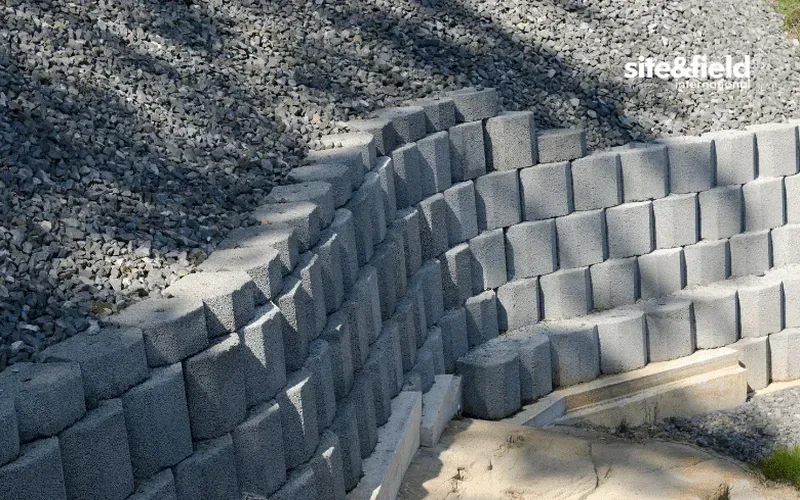
A homeowner near Kempenfelt Bay decided to terrace their backyard to gain a lake view. The excavation looked straightforward until a spring storm saturated the exposed sandy till. The temporary cut slumped overnight, and the project sat idle for weeks. That’s when our team was called in to design a permanent retaining wall that accounted for the seasonal water table and the 2.4 m frost depth Barrie sees every winter. In a city where over 150,000 people live on the transition between the Canadian Shield and the Simcoe Lowlands, retaining wall design is rarely a copy-and-paste exercise. We start every assignment with a test pit investigation to log the stratigraphy firsthand, then pair it with a grain-size analysis to confirm drainage characteristics before a single concrete block is specified.
A retaining wall in Simcoe County isn’t just a concrete face—it’s a drainage system that happens to hold back soil.
Process overview
Local context
Barrie sits at 220 m above sea level on the western edge of the Lake Simcoe basin, and that elevation drop toward the water concentrates groundwater flow paths that many builders underestimate. The 2022–2023 construction season recorded over 900 mm of precipitation across the region, and when that volume hits a poorly drained retaining wall, hydrostatic pressure builds fast. We’ve investigated walls in the Holly and Ardagh neighborhoods where the bottom course of blocks had shifted 40 mm outward—not because the wall was under-designed structurally, but because the original builder didn’t account for the perched water table that rises in late March. Our designs always include a minimum 300 mm free-draining zone behind the wall and a positive slope on the subdrain to daylight or a sump. On projects within 30 m of Lake Simcoe, we also evaluate wave-induced erosion at the toe using FEMA and MNRF guidance, because a scoured base is the fastest route to a collapse that no amount of reinforcement can stop.
Relevant standards
NBCC 2020 (National Building Code of Canada – structural loads and importance factors), CSA A23.3:19 (Design of concrete structures, including retaining walls), OPSS.MUNI 1010 (Ontario Provincial Standard Specification – granular backfill materials), MTO Foundation Engineering Manual (frost depth and retaining structure guidance for Ontario)
Additional services
Structural retaining wall design
Full engineering package with wall geometry, reinforcement schedules, drainage details, and bearing capacity verification. Suitable for municipal permitting and contractor tendering.
Geotechnical investigation for wall design
On-site SPT drilling and test pitting to determine soil parameters, groundwater elevation, and backfill recommendations before wall type selection begins.
Typical parameters
Top questions
How much does a retaining wall design cost in Barrie?
For most residential and light commercial walls in the Barrie area, the engineering design fee ranges from CA$1,450 to CA$5,060, depending on wall height, the number of soil borings or test pits required, and whether slope stability analysis is needed. Taller walls over 3 meters, or those near Lake Simcoe requiring toe scour evaluation, fall toward the upper end.
What soil information do you need before designing a retaining wall in Barrie?
We need at least one test pit or borehole at the wall location to log the soil profile, measure groundwater depth, and collect samples for grain-size and Atterberg limits testing. In Barrie’s silty till deposits, knowing the plasticity index is critical for predicting lateral earth pressure and drainage behavior.
How long does the design and approval process take for a Barrie retaining wall?
Once site investigation data is available, design and stamped drawings typically take 10 to 15 business days. If a building permit is required through the City of Barrie, the review timeline depends on the complexity of the wall—simple gravity walls under 1 meter often qualify for fast-track review, while taller reinforced structures may require a more detailed engineering submission.