The soil story changes fast when you move from the sandy ridges near Kempenfelt Bay to the silty clays behind the Lake Simcoe plain. A footing that drains freely on a well-graded sand in the south end can sit in a frost-susceptible silt just two concessions north. That contrast is exactly why we run a full grain size analysis—sieve stack plus hydrometer—on every sample that comes through our Barrie lab. Without the hydrometer fraction, you miss the fines that control heave, drainage, and compaction. The atterberg limits suite becomes the natural next step once the gradation curve flags a borderline silt, and we often pair both data sets for subdivision earthworks where the geotechnical report has to hold up through a wet spring and a Barrie winter.
A hydrometer reading that catches 8% clay where the eye saw silt can flip a Barrie foundation design from conventional to frost-protected.
Process overview
Local context
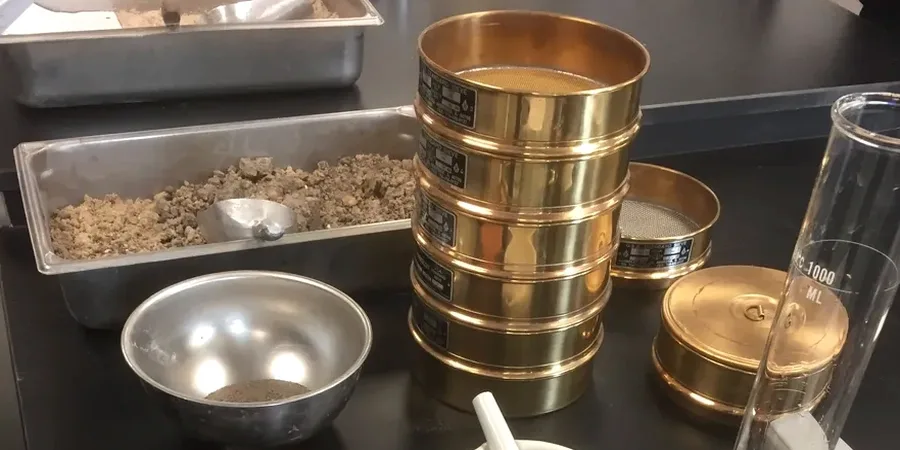
The lab bench for our grain size work in Barrie is built around a Ro-Tap sieve shaker and a controlled-temperature hydrometer bath that keeps the sedimentation cylinder at 20°C within half a degree—because a two-degree drift shifts the viscosity enough to throw the clay fraction by several percent. The real risk we guard against is a classification that misses the fines tail. A brown silty sand that plots as SW on the sieve alone can turn into SM with 18% fines once the hydrometer data comes in, and that reclassification changes the allowable bearing pressure, the drainage recommendation, and the frost-protection depth. Barrie's freeze-thaw cycles penetrate deep into silty soils, and a gradation curve that ignores the minus-75-µm fraction leaves the structural engineer blind to the heave potential. We run every hydrometer with a blank control cylinder and a temperature correction logged every 15 minutes, because the difference between 4% and 8% clay is the difference between a standard footing and an insulated shallow foundation.
Relevant standards
ASTM D6913/D6913M-17 (sieve analysis), ASTM D7928-21 (hydrometer analysis), ASTM D2487-17 (USCS classification), Ontario Building Code O. Reg. 332/12 (frost protection)
Additional services
Combined Sieve & Hydrometer (Full Particle-Size Distribution)
Covers the complete range from coarse gravel to clay colloids, meeting the data requirements for USCS classification, internal drainage design, filter compatibility, and frost-susceptibility assessment per ASTM D6913 and D7928. Every curve includes D10, D30, D60, Cu, Cc, and mass percentages for each fraction.
Wash-Only Fines Content Check (Rapid Lab Turnaround)
A streamlined wash-sieve procedure for contractors who only need the percent passing the No. 200 sieve—useful for confirming granular borrow quality or tracking fines migration during compaction. Results are typically available within one business day when samples arrive before noon.
Typical parameters
Top questions
How much does a sieve and hydrometer grain size analysis cost at the Barrie lab?
A complete combined analysis (sieve stack plus hydrometer) typically runs between CA$130 and CA$250 per sample, depending on whether you need the full hydrometer settlement curve or just the percent-finer-than-75-µm fraction. We quote a firm price when we see the material, because a clean sand needs less lab time than a fat clay that requires extended sedimentation readings.
Why do I need the hydrometer part when the sieve already shows everything above 75 microns?
The sieve stops at the No. 200 mesh, so anything finer—silts and clays—stays unmeasured. In Barrie's glaciolacustrine deposits, the silt-plus-clay fraction often controls frost heave, drainage rate, and compaction behavior. A hydrometer reading gives you the clay-size percentage and the D10 that you need for filter design and for checking whether a soil is frost-susceptible under the Ontario Building Code.
What sample size do you need for a full grain size analysis?
We ask for about 2 kg of material in a sealed bag, taken from a representative split. For the hydrometer, we only need the minus-No. 200 portion, so if the soil is mostly sand, a larger initial mass ensures we recover enough fines. We can split the sample at the lab if the field crew sends a larger bulk bag, which is common on Barrie subdivision jobs where multiple tests come from the same stockpile.
How fast can I get results for a grain size analysis in Barrie?
Standard turnaround is three business days. The hydrometer sedimentation reading takes a minimum of 24 hours because the fine fraction settles slowly. We offer a 24-hour rush service when samples arrive early in the day and the soil is predominantly granular, but a clay-rich sample will always need the full sedimentation period to meet ASTM D7928.