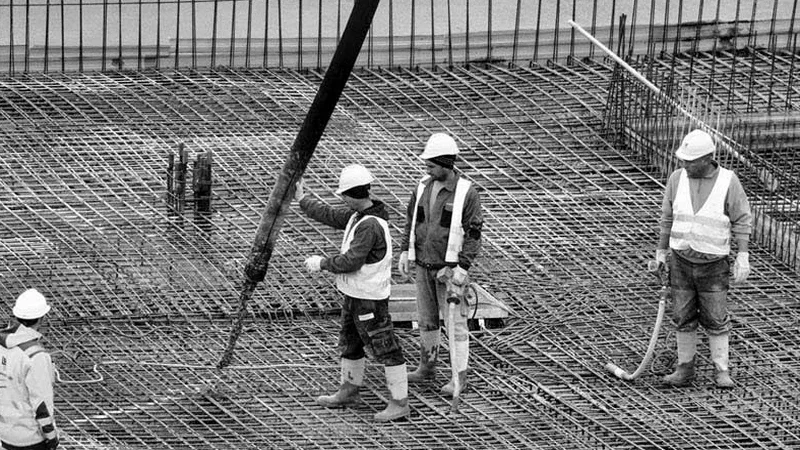
Barrie sits on a complex blanket of glaciolacustrine clay and silt, the legacy of glacial Lake Algonquin. Near Kempenfelt Bay, the water table can sit just 1.5 meters below grade. That combination — soft compressible layers with shallow groundwater — makes differential settlement the primary geotechnical challenge here. A raft/mat foundation design spreads structural loads across a continuous reinforced slab, bypassing the need for deep piles in moderate-load scenarios. In our lab, we characterize the subsurface with triaxial shear strength and consolidation tests before finalizing any raft geometry. The NBCC 2020 seismic provisions, paired with CSA A23.3, demand careful detailing when the raft also serves as the seismic diaphragm. For projects on the south end near the Simcoe County forest tracts, we often combine the raft analysis with a slope stability review where grading cuts approach the foundation perimeter.
A raft foundation does more than distribute load — it bridges the soft spots in Barrie's glaciolacustrine stratigraphy, and the lab data proves whether it works.
Process overview
Local context
At 44.3893 north, Barrie endures freeze-thaw cycling that reaches 1.2 meters depth in an average winter. A raft/mat foundation design without proper frost protection will heave at the edges. The bigger hidden risk is long-term consolidation settlement in the varved clay sequence — we have seen differential movements exceed 40 mm over ten years when the raft was undersized. That cracks partition walls and binds doors. The 2021 tornado event also reminded everyone that wind uplift on light structures can couple with soil softening, demanding a solid slab-to-wall connection. Our lab tests the consolidation parameters (C_c, C_r) and the undrained shear strength to feed a realistic settlement-time curve. If the raft is your chosen system, the numbers must come from a local lab that knows the Lake Simcoe basin stratigraphy.
Relevant standards
NBCC 2020 (Division B, Part 4 — Structural Design), CSA A23.3:19 (Design of Concrete Structures), CSA + ASTM D2435 (One-Dimensional Consolidation Properties), CSA + ASTM D2850 (Unconsolidated-Undrained Triaxial)
Additional services
Consolidation and Settlement Analysis
Incremental oedometer tests on Shelby tube samples from the varved clay strata. We report C_c, C_r, preconsolidation pressure, and coefficient of consolidation to build the settlement-time curve for the raft footprint.
Triaxial Shear Strength Testing
UU and CIU triaxial tests to define undrained shear strength and effective stress parameters. These values determine the bearing capacity factor and the short-term stability of the excavation for the raft pour.
Typical parameters
Top questions
What is the typical cost range for a raft foundation design package in Barrie?
For a standard residential or light commercial raft/mat foundation in Barrie, the geotechnical investigation and design report typically ranges from CA$1,570 to CA$5,110, depending on the number of boreholes, lab tests required, and the complexity of the groundwater conditions near the bay.
How does the high water table in Barrie affect raft foundation performance?
The water table reduces the effective stress in the soil, which lowers bearing capacity and increases settlement. We use submerged unit weights in the analysis and often specify a granular drainage blanket beneath the raft to manage pore pressure buildup during the consolidation phase.
Do I need a raft foundation or are footings enough for my Barrie lot?
It depends on the compressibility profile. If our lab tests show more than 15 mm of differential settlement with isolated footings, a raft becomes the safer choice. We compare both options in the report using the same site-specific consolidation data.
Which lab tests are mandatory for a raft foundation design report?
At minimum, we run oedometer consolidation tests and unconsolidated-undrained triaxial tests on undisturbed samples from the bearing stratum. Atterberg limits and grain-size distribution are also performed to classify the soil according to ASTM D2487, which feeds the bearing capacity calculations.